
So you laced up, headed out, and ran out of breath before the end of the street. Sound familiar? You're not doing it wrong, and you're not "not a runner". You started where almost everyone starts, and then tried to skip the first step.
The first step is 1 minute. Yes, just 1!
Start smaller than you think
The usual way to start running from nothing is run/walk: short runs with walks in between, growing a little each week. The NHS's beginner plan starts with 1 minute of running and 90 seconds of walking, 3 times a week, and builds from there.
Starting small matters: research suggests most beginners who stop do so early. In a UK study of a beginner programme, most people didn't finish it, and about three-quarters of those who dropped out did so in the first half (Relph and colleagues, 2023).
Research suggests injury is the main reason beginners give for stopping: it was in that study, and in a study of novice runners after their programme ended (Fokkema and colleagues, 2019).
Research also suggests that new runners get injured more than twice as often, per hour of running, as people who already run (Videbæk and colleagues, 2015). So the first weeks call for care: short runs, small steps up, and rest days. There is some evidence that big jumps are what put people off, too: in interviews, people who left a beginner programme described the jump in week 5 as too fast (Relph and colleagues, 2023).
So here's the thing about the walks: they aren't a break from the training. They're part of it. Your breathing settles, and you're ready for the next run. Over the weeks, the running parts grow, until one day the walks are gone.
What your first run looks like
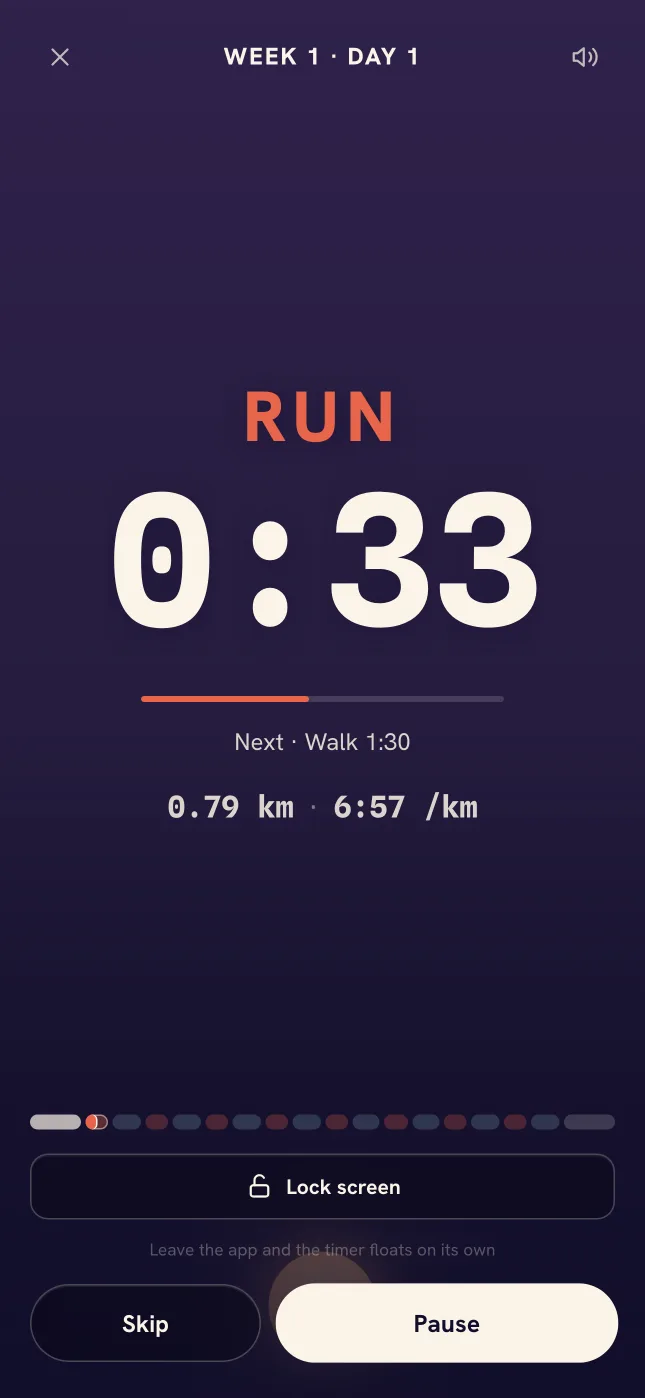
Run 1 of Rise to 5K looks like this:
- 5 minutes of brisk walking to warm up.
- 1 minute of jogging, then 1 minute 30 of walking, 8 times over.
- 5 minutes of walking to cool down.
That's about 30 minutes in all. A voice tells you when each part starts, over your music or podcast, so you don't need to watch the clock. Phone in your pocket, screen off, and you just follow the voice.
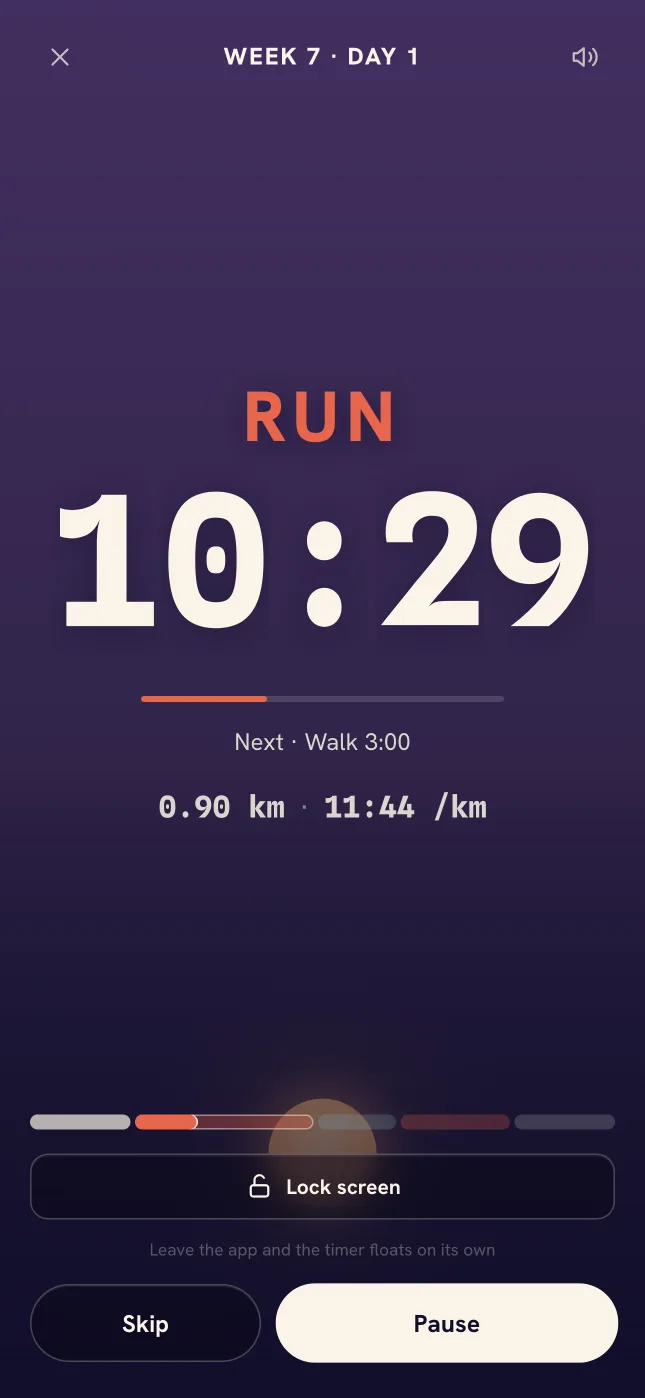
When I was testing the app, one tester told me run 1 felt like a breeze. By week 2? Brutal. And you know what, that's normal. It's also why the app lets you rate a run "Brutal": when you do, it suggests running that day again, and that's part of the plan, not a step back.
How fast should you go?
Slower than you think. A good check is whether you can still talk in short sentences while you jog. Research suggests talking first gets hard at about the point where breathing gets hard, which makes the "talk test" a simple way to keep a run gentle (Persinger and colleagues, 2004). With runs this short, check near the end of each one. If you can't get a sentence out, slow down until you can.
There's a good reason to keep it gentle beyond comfort. Research suggests exercise tends to feel pleasant below that breathing threshold and unpleasant above it, and that people cope better with efforts they choose for themselves (Ekkekakis and colleagues, 2011). In one study, beginners who trained by feel, at an effort they rated "somewhat hard", got fitter and enjoyed it more over time (Parfitt and colleagues, 2012).
There's no speed you're meant to hit. The only goal on run 1 is to finish it, and to want to come back for run 2.
The 8 weeks, in short
You'll run 3 times a week, with a rest day between runs, which is what the NHS plan advises too (NHS). The running parts grow a little each week: from 1 minute, to 3, to 5, and on. By week 6 you're running for 10 minutes at a time. The last run of the plan is a full 5K, and it ends when you reach 5 km, not on the clock.
If a run felt too hard, or life gets in the way, running the same day again is a normal part of the plan, not a step back. The NHS plan says the same. Rise to 5K suggests a repeat when a run was hard or after time away, and you can run any earlier day again.
Believing you can
Here's the part people tend to skip. How you think about it matters more than you might expect. Research suggests that believing you can do it is the most consistent predictor of who keeps exercising: a review of 37 studies found it was the only factor that predicted lapses again and again (Roordink and colleagues, 2023). And there's some evidence it holds for new runners: in a study of beginner running groups, it predicted who went on to reach 30 minutes of running (Plateau and colleagues, 2024).
And there's some evidence that people become runners by running: many parkrunners who arrived calling themselves non-runners came to see themselves as runners over time (Bowness and colleagues, 2021). You don't need to feel like a runner to start. That part comes later.
What's normal the next day
Stiff or sore legs a day or 2 after starting are normal, and research suggests the soreness fades over several days (Cheung and colleagues, 2003), sometimes taking up to a week (Newcastle Hospitals NHS). A rest day between runs gives your body time to catch up.
Soreness isn't the same as injury. The NHS advises getting checked if you have swelling, bruising, sharp pain in 1 spot, or can't put weight on a leg, and getting urgent advice for severe or worsening pain (NHS).
Before you start, and on every run
Check with a doctor before you start if you've had chest pain, dizziness or fainting during activity, heart disease, very high blood pressure, or a condition that limits exercise (Singapore Physical Activity Guidelines).
On any run, stop and call for emergency help for tight or squeezing chest pain, chest pain spreading to your arm, neck or jaw, severe breathlessness, or a collapse (NHS). In the heat, stop, get into shade and cool down if you feel dizzy or sick, get a bad headache, cramps, chills or goosebumps, or your heart is pounding and you can't catch your breath (Sport Singapore, NHS). If you don't feel better within 30 minutes of cooling down, or you feel worse, get medical help. And any confusion, clumsiness or odd behaviour in the heat needs urgent help: call your local emergency number (NHS).
Start tonight, or tomorrow morning
You don't need to be a runner to start. You don't need the gear, the watch or the "runner's body" either. You need about 30 to 45 minutes, 3 times a week, and a reason to come back. The rest really does come one run at a time.
Why did I build Rise to 5K in the first place? That's a story for its own post. For now, run 1 is about 30 minutes away. See you at sunrise.
Sources
- NHS. Couch to 5K: the running plan, and Get running with Couch to 5K. Running plan, Get running.
- Relph N, Taylor SL, Christian DL, Dey P, Owen MB. 2023. "Couch-to-5k or Couch to Ouch to Couch!?" Who takes part in beginner runner programmes in the UK and is non-completion linked to musculoskeletal injury? Int J Environ Res Public Health 20(17):6682. Link
- Fokkema T, Hartgens F, Kluitenberg B, et al. 2019. Reasons and predictors of discontinuation of running after a running program for novice runners. J Sci Med Sport 22(1):106-111. Link
- Videbæk S, Bueno AM, Nielsen RO, Rasmussen S. 2015. Incidence of running-related injuries per 1000 h of running in different types of runners: a systematic review and meta-analysis. Sports Med 45(7):1017-1026. Link
- Persinger R, Foster C, Gibson M, Fater DC, Porcari JP. 2004. Consistency of the talk test for exercise prescription. Med Sci Sports Exerc 36(9):1632-1636. Link
- Ekkekakis P, Parfitt G, Petruzzello SJ. 2011. The pleasure and displeasure people feel when they exercise at different intensities. Sports Med 41(8):641-671. Link
- Parfitt G, Evans H, Eston R. 2012. Perceptually regulated training at RPE13 is pleasant and improves physical health. Med Sci Sports Exerc 44(8):1613-1618. Link
- Roordink EM, Steenhuis IHM, Kroeze W, et al. 2023. Predictors of lapse and relapse in physical activity and dietary behaviour: a systematic search and review on prospective studies. Psychol Health 38(5):623-646. Link
- Plateau CR, Anthony J, Clemes SA, Stevinson CD. 2024. Prospective study of beginner running groups: psychological predictors and outcomes of participation. Behav Med 50(1):55-62. Link
- Bowness J, McKendrick JH, Tulle E. 2021. From non-runner to parkrunner: subjective athletic identity and experience of parkrun. Int Rev Sociol Sport 56(5):695-718. Link
- Cheung K, Hume P, Maxwell L. 2003. Delayed onset muscle soreness: treatment strategies and performance factors. Sports Med 33(2):145-164. Link
- Newcastle upon Tyne Hospitals NHS Foundation Trust. Exercise and your health: a guide to getting started. Link
- NHS. Sprains and strains. Link
- NHS. Heart attack. Link
- NHS. Heat exhaustion and heatstroke. Link
- Sport Singapore. 2024. Heat Stress Management Plan. Link
- Health Promotion Board and Sport Singapore. 2022. Singapore Physical Activity Guidelines, revised edition. Link