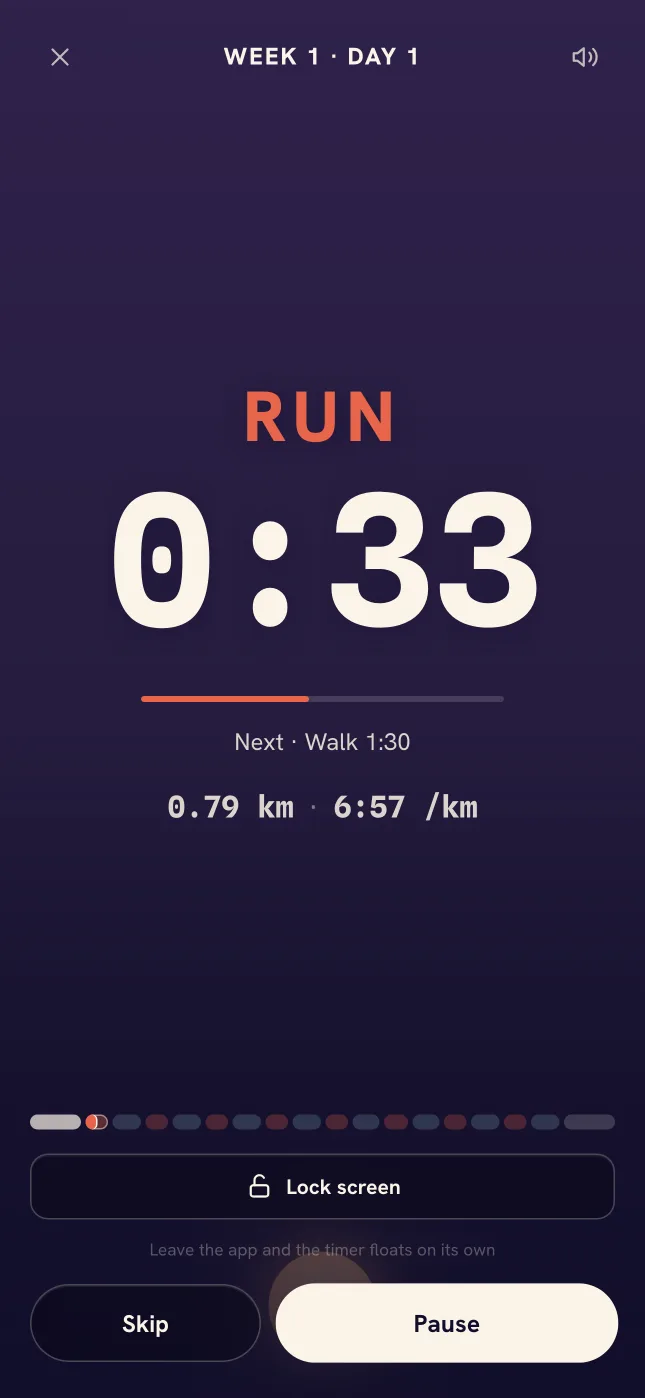
"How long until I can run 5K?" It's a fair first question. The plan is 8 weeks, and if it takes you longer, that's fine.
What the 8 weeks look like
Rise to 5K is 8 weeks, with 3 runs a week. That's 24 runs, each about 30 to 45 minutes including a 5 minute walk at each end. The NHS's beginner plan takes 9 weeks, also with 3 runs a week and rest days in between (NHS).
Here's how the running grows across those 8 weeks:
Week 1 is 1 minute of running at a time. Week 7 brings your first run with no walk in the middle. And the very last run is a full 5K.
When it takes longer than 8 weeks
Life happens. You catch a cold, work gets busy, the weather turns, or a run just goes badly. Any of those can add a week, and none of them means you're doing it wrong.
The NHS plan says it's fine to repeat a run or a week. Rise to 5K builds that in. Rate a run "Brutal" and it suggests repeating that run next time. Rate the same run "Brutal" twice in a row, and it suggests starting that week again. Every suggestion is optional, and you can run any earlier day again whenever you like.
Research suggests habits take a while to form, longer than most beginner plans last, and that missing 1 day didn't set people back much (Lally and colleagues, 2010). So if you miss a run, just do the next one.
What slows people down
Time away. Research suggests fitness you've only recently gained fades if you stop for more than about 4 weeks (Mujika and Padilla, 2000). Shorter breaks cost much less. Rise to 5K takes this into account. After 7 days away it suggests repeating your last run, and after 14 days, starting that week again. It never sends you back further than the start of that week.
Being unwell. If it's hot where you run, sports medicine advises against exercising in the heat with a fever, a chest infection, diarrhoea or vomiting (ACSM). Rest, get better, and pick up again.
Doing too much, too soon. This is the big one. Research suggests injury is the main reason beginners give for stopping (Fokkema and colleagues, 2019), and that most who stop do so early: in a UK study of a beginner programme, about 3 in 4 of the people who dropped out did so in the first half (Relph and colleagues, 2023). If you need an extra week early on, that's normal.
What "running 5K" actually means
Running 5K just means getting to 5 km. There's no time to beat. The last run in Rise to 5K is called "Run 5 km", and it's done when you reach 5 km.
GPS isn't perfect, either. Research suggests sports watches mis-measure distance by about 3 to 6% on average, more among tall buildings and under trees (Gilgen-Ammann and colleagues, 2020). Don't worry if another device reads a bit over or under.
On a treadmill? Choose Treadmill on the screen before the run. When you reach 5 km, tap Done, then enter the treadmill's total on the finish screen.
After 8 weeks (or 10, or 12)
Research suggests beginner programmes do change what people do: in a Dutch study, graduates of a 6-week beginner running programme were more active than similar people 6 months later (Ooms and colleagues, 2013).
Believing you can do it matters too. Research suggests confidence that you can keep going is the most consistent predictor of who sticks with exercise (Roordink and colleagues, 2023). My wife always said she couldn't run. She finished her 5K, and she's still running.
So, about 8 weeks if things go to plan. A bit longer if they don't, and they often don't! Week 8 or week 12, the sun still comes up at the end. See you there.
Sources
- NHS. Couch to 5K: the running plan, and Get running with Couch to 5K. Running plan, Get running.
- Lally P, van Jaarsveld CHM, Potts HWW, Wardle J. 2010. How are habits formed: modelling habit formation in the real world. Eur J Soc Psychol 40(6):998-1009. Link
- Mujika I, Padilla S. 2000. Detraining: loss of training-induced physiological and performance adaptations. Part II: long term insufficient training stimulus. Sports Med 30(3):145-154. Link
- Armstrong LE, Casa DJ, Millard-Stafford M, Moran DS, Pyne SW, Roberts WO (American College of Sports Medicine). 2007. Exertional heat illness during training and competition. Med Sci Sports Exerc 39(3):556-572. Link
- Relph N, Taylor SL, Christian DL, Dey P, Owen MB. 2023. "Couch-to-5k or Couch to Ouch to Couch!?" Who takes part in beginner runner programmes in the UK and is non-completion linked to musculoskeletal injury? Int J Environ Res Public Health 20(17):6682. Link
- Fokkema T, Hartgens F, Kluitenberg B, et al. 2019. Reasons and predictors of discontinuation of running after a running program for novice runners. J Sci Med Sport 22(1):106-111. Link
- Gilgen-Ammann R, Schweizer T, Wyss T. 2020. Accuracy of distance recordings in eight positioning-enabled sport watches: instrument validation study. JMIR Mhealth Uhealth 8(6):e17118. Link
- Ooms L, Veenhof C, de Bakker DH. 2013. Effectiveness of Start to Run, a 6-week training program for novice runners, on increasing health-enhancing physical activity: a controlled study. BMC Public Health 13:697. Link
- Roordink EM, Steenhuis IHM, Kroeze W, et al. 2023. Predictors of lapse and relapse in physical activity and dietary behaviour: a systematic search and review on prospective studies. Psychol Health 38(5):623-646. Link