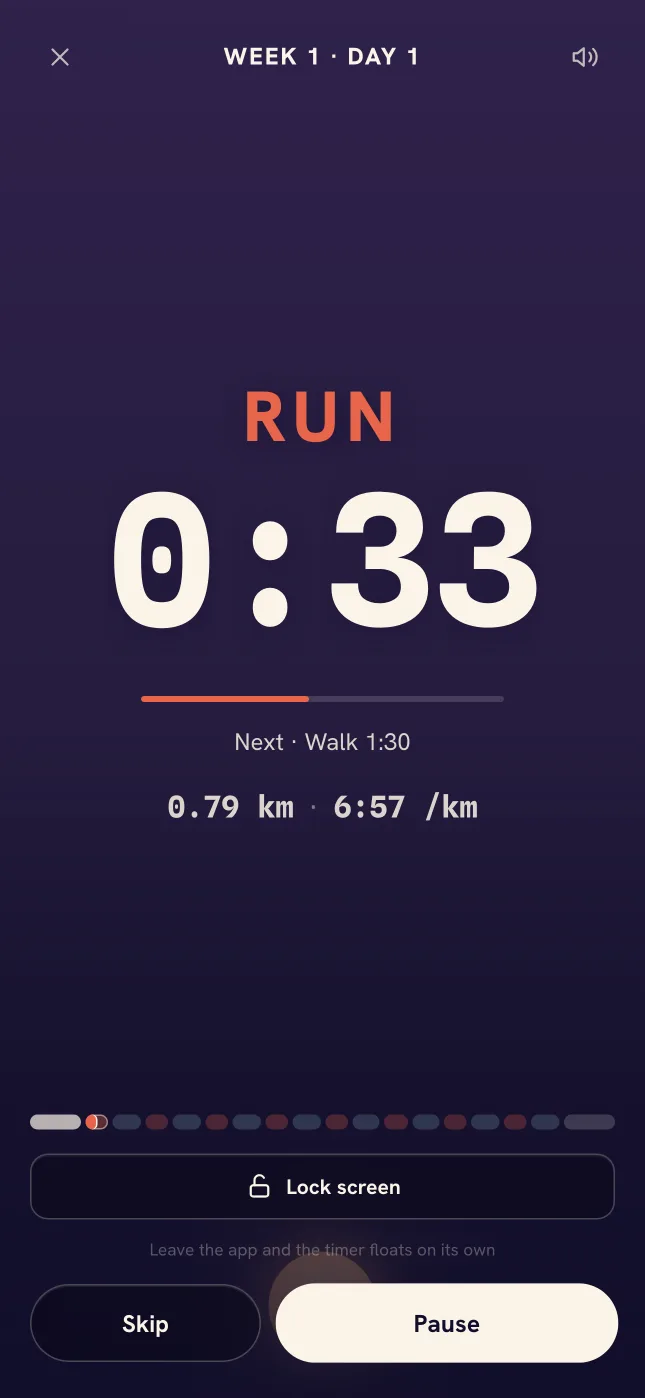
If you've ever watched someone stop to walk mid-run and thought "that's cheating", I get why it looks that way. But if you're starting from nothing, the walks are part of the plan.
What run/walk is
Run/walk means short spells of running with walks in between, in a set pattern. It's the usual way to start from zero. The NHS's beginner plan opens with 1 minute of running and 90 seconds of walking, and builds over 9 weeks to 30 minutes of running without stopping.
Rise to 5K works the same way over 8 weeks. Every run starts and ends with a 5 minute walk, and in between, the plan sets out when you run and when you walk. A voice tells you each change, so you never have to decide when to stop or start. That's the bit people miss. The walks are set in advance as part of the training, so you don't wait until you're tired to take one.
Why it works for beginners
Run/walk lets you spend 30 minutes on your feet, at a gentle effort, long before you could run for 30 minutes. Week 1 asks for 1 minute of running at a time, with time to recover in between, and builds from there.
Research suggests exercise tends to feel pleasant below the point where your breathing gets hard, and unpleasant above it (Ekkekakis and colleagues, 2011). Short spells of running keep you on the right side of that line more of the time. And research suggests that training by feel works: beginners who trained at an effort they rated "somewhat hard" got fitter and enjoyed it more over the weeks (Parfitt and colleagues, 2012).
A simple check is whether you can still talk. Research suggests talking first gets hard at about the point where breathing gets hard, which makes the "talk test" a handy guide for a steady effort (Persinger and colleagues, 2004). In short spells your breathing takes a moment to catch up, so check near the end of each run, not the start (Foster and colleagues, 2018).
What the research says, and doesn't
Here's where I want to be careful, because run/walk gets oversold.
Most of the research on planned walk breaks is in marathon runners, not beginners. In 1 study, non-elite marathoners who took planned walk breaks finished in about the same time as those who ran the whole way (4:14 against 4:08, not a real difference), and had less muscle pain and tiredness afterwards (Hottenrott and colleagues, 2016). That's encouraging, but it was 42 people running a marathon, which is a long way from week 1.
Walk breaks don't save energy either. In 1 lab study, 2 minute run and walk spells cost slightly more energy per kilometre than running steadily (Nolan and Moore, 2021). So any benefit is in how the run feels.
And you'll often read that walk breaks prevent injury. No study shows that. The claim comes from coaches' own material, not from research, so I won't make it here.
For a beginner, the main thing the walks do is let you finish the run, and come back for the next one.
Week by week
Over 8 weeks, the running spells grow and the walks shrink:
- Week 1: 1 minute of running, 1 minute 30 of walking, 8 to 10 times over.
- Week 3: 3 to 5 minutes of running, with 2 to 3 minutes of walking.
- Week 4: up to 9 minutes of running at a time.
- Week 6: 10 to 15 minutes at a time, with 1 walk in the middle.
- Week 7: your first run with no walk in the middle: 22 minutes straight.
- Week 8: no walks at all, between the warm-up and cool-down, ending with a full 5K.
Here's week 4's first run, for comparison with week 1 above:
Week 5 deliberately eases back before the next step up. There's some evidence that sudden jumps are what put people off: in interviews, people who left a beginner programme described its jump in week 5 as too fast (Relph and colleagues, 2023). So in Rise to 5K, the runs grow slowly, with no big jumps.
When a run feels too hard
Some runs will, and that's normal. Don't push through pain. After each run, the app asks how it felt. Rate it "Brutal" and it suggests repeating that run next time. You decide, and you can run any earlier day again too. Repeating a run or a week is normal, and the NHS plan says that's fine.
If you ever feel sharp pain in 1 spot, chest pain, or faint, stop. Those aren't part of any plan. The NHS advises calling for emergency help for tight or squeezing chest pain, pain spreading to your arm, neck or jaw, or severe breathlessness.
Stick with the walks
I know the walks can feel like they're holding you back. They're part of the plan, and over the 8 weeks they get shorter, until by week 8 they're gone. See you at sunrise.
Sources
- NHS. Couch to 5K: the running plan. Link
- Ekkekakis P, Parfitt G, Petruzzello SJ. 2011. The pleasure and displeasure people feel when they exercise at different intensities. Sports Med 41(8):641-671. Link
- Parfitt G, Evans H, Eston R. 2012. Perceptually regulated training at RPE13 is pleasant and improves physical health. Med Sci Sports Exerc 44(8):1613-1618. Link
- Persinger R, Foster C, Gibson M, Fater DC, Porcari JP. 2004. Consistency of the talk test for exercise prescription. Med Sci Sports Exerc 36(9):1632-1636. Link
- Foster C, Porcari JP, et al. 2018. Exercise prescription when there is no exercise test: the talk test. Kinesiology 50(Suppl 1). Link
- Hottenrott K, Ludyga S, Schulze S, Gronwald T, Jäger FS. 2016. Does a run/walk strategy decrease cardiac stress during a marathon in non-elite runners? J Sci Med Sport 19(1):64-68. Link
- Nolan WP, Moore AR. 2021. Run-walk marathon pacing: the energy cost of frequent walk breaks. Int J Perform Anal Sport 21(1):170-179. Link
- Relph N, Taylor SL, Christian DL, Dey P, Owen MB. 2023. "Couch-to-5k or Couch to Ouch to Couch!?" Who takes part in beginner runner programmes in the UK and is non-completion linked to musculoskeletal injury? Int J Environ Res Public Health 20(17):6682. Link
- NHS. Heart attack. Link